Rooibos Isn't Tea at All, and That's Why It Has No Caffeine
Rooibos sits on the same shelf as tea, gets steeped the same way, and even goes through something producers call fermentation. None of that makes it tea. Every post on this site so far has covered a different way of processing Camellia sinensis, the actual tea plant. Rooibos isn't that plant, isn't in the same family as that plant, and its lack of caffeine has nothing to do with processing at all.
A legume, not a tea leaf
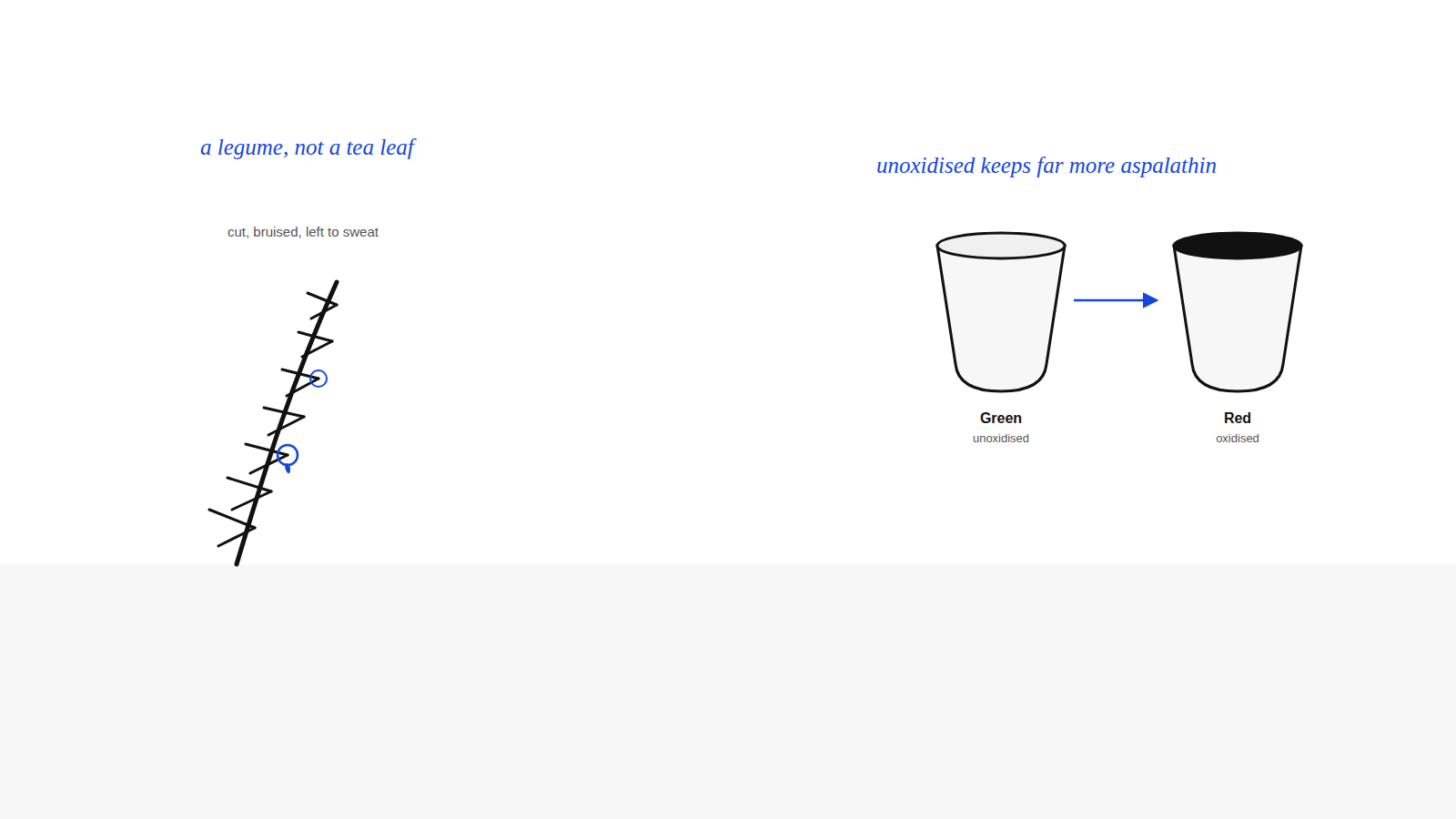
Rooibos comes from Aspalathus linearis, a shrub in the legume family, the same broad plant family as beans and peas, grown almost exclusively in South Africa's Cederberg region, where the climate and sandy, acidic soil suit it in a way few other places do. It doesn't resemble a tea bush at all: instead of broad, oval leaves, it grows thin, needle-like leaves on a woody stem, closer in shape to rosemary than to tea.
No caffeine because there was never any to remove
An earlier post on this site covered how coffee gets decaffeinated: caffeine is extracted from the bean by water, carbon dioxide or a solvent, and even the best method leaves a small residue behind. Rooibos skips all of that, not because its processing is more thorough, but because the plant never produces caffeine in the first place. Caffeine production is a trait of specific plant lineages, including Camellia sinensis and coffee's Coffea species, not something legumes generally make. A cup of rooibos reads as zero caffeine, not heavily reduced caffeine, because there was nothing there to begin with.
A different kind of "fermentation"
Rooibos producers do use the word fermentation for a step that, physically, looks a lot like how tea gets oxidised: cut stems and leaves are bruised, usually with rollers, which ruptures plant tissue and lets enzymes reach compounds that would otherwise stay separate. The material is then left in moist heaps to "sweat" before drying. But the actual chemistry is specific to rooibos. Its signature compound, aspalathin, isn't found in meaningful amounts in tea at all; during this oxidation step, aspalathin breaks down into intermediate compounds and then polymerises into the darker, high-molecular-weight pigments responsible for rooibos's characteristic red-brown colour. It's a related process to tea's own oxidation, bruising exposing enzymes to substrates, but running on an entirely different set of molecules.
Green rooibos: the version that skips this step
Green rooibos simply bypasses the oxidation stage and is dried right after harvesting, the same logic behind green tea skipping oxidation to preserve catechins. Because aspalathin isn't allowed to break down, green rooibos keeps far more of it: a comparison of commercial South African teas measured roughly ten times more aspalathin in green rooibos than in standard red rooibos, with close to double the antioxidant capacity in the same lab assays. That evidence comes from in vitro testing and a nematode model, not human trials, so it says more about what's chemically present in the cup than about any proven effect on a person drinking it, worth being precise about rather than overselling.
Rooibos earns its place next to tea because it's brewed the same way and fills the same role in a cup, hot water, a few minutes, a mug at the end of it, but botanically and chemically it's its own thing entirely, down to a pigment-forming compound that doesn't exist in any tea plant.