Roast Level Isn't a Flavour Choice Layered on Top, It's How Far the Reaction Went
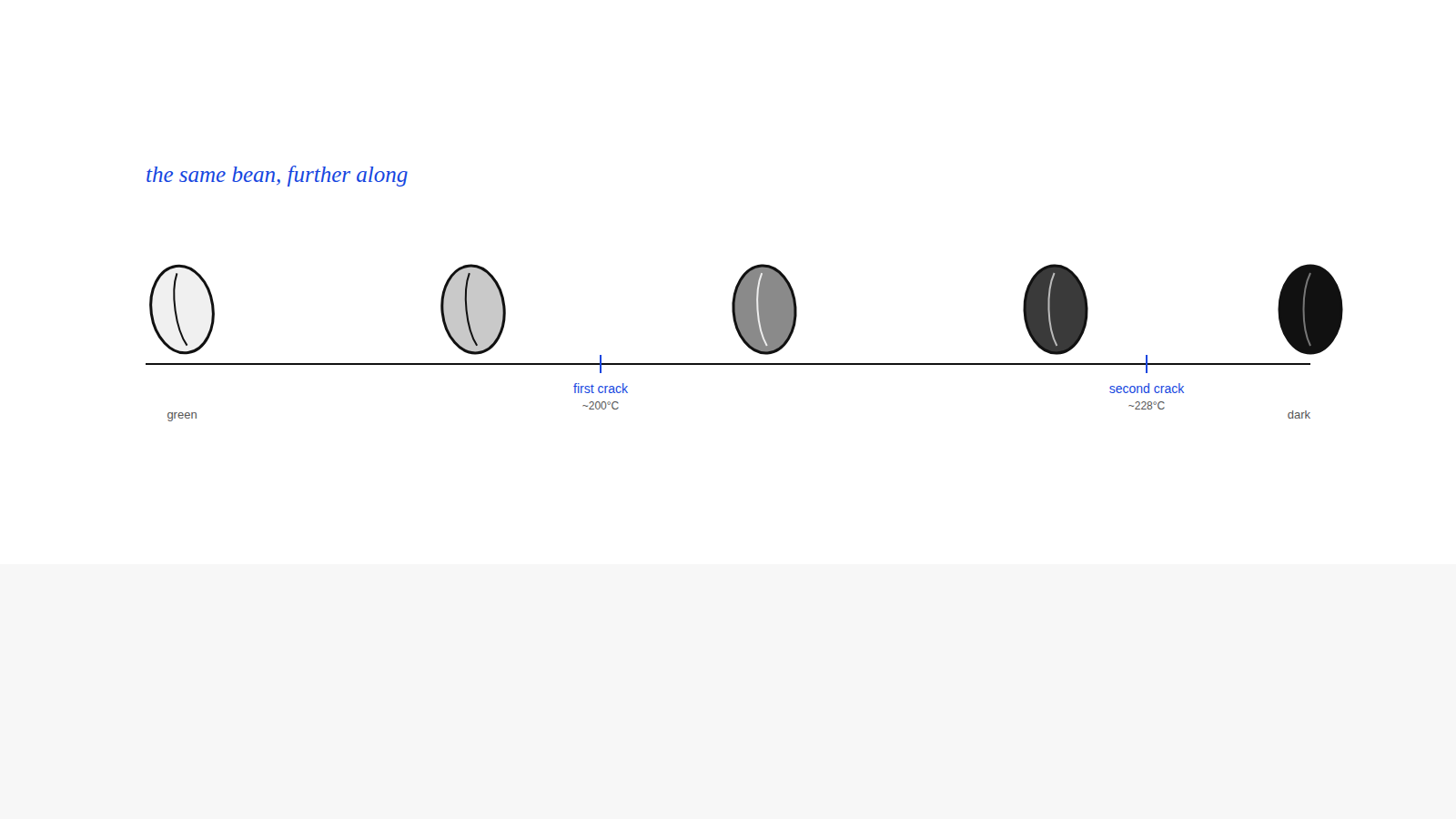
Light, medium and dark roast get talked about like three different products, as if a roaster picks a flavour profile the way a brewer picks a recipe. They're not separate recipes. Every roast level starts from the same green bean and runs through the same sequence of chemical reactions; the only real variable is how far along that sequence the roaster chooses to stop.
Maillard first, then caramelisation
The first major transformation is the Maillard reaction, the same browning reaction responsible for a seared steak or toasted bread, between amino acids and reducing sugars in the bean. It accelerates in roughly the 120 to 150°C range, and it's responsible for much of coffee's roasted aroma and its initial shift from green to brown. As the bean keeps heating past about 170°C, a separate process, caramelisation of the bean's sugars, takes over and continues browning the bean further. This is where the trade-off that defines roast level actually starts: caramelisation steadily trades sweetness for bitterness the longer it runs.
Two audible cracks, two real transitions
Roasters time their roasts by sound. First crack, an audible pop as the bean's internal moisture flashes to steam and ruptures its cell structure under pressure, happens at roughly 196 to 205°C and marks the point a bean is minimally roasted enough to drink: stopping shortly after first crack produces a light roast. Pushing further, the bean keeps losing mass and its structure keeps breaking down until second crack, a sharper, more popcorn-like sound caused by the cell walls fracturing further as oils are forced toward the surface, arrives at roughly 224 to 232°C. Beans pulled around or after second crack are what's sold as dark roast, visibly oilier and markedly more bitter.
Where the brightness goes
Chlorogenic acids are the main compounds behind coffee's perceived acidity and brightness, and they degrade steadily as roasting continues: studies measuring this consistently find the same direction of change even though the exact magnitude varies a lot by method and roast intensity, with reported reductions ranging from roughly 30 percent in moderately dark roasts up to 80 percent or more under more aggressive roasting, and extreme lab conditions pushing past 99 percent. That range is wide because chlorogenic acid retention depends heavily on how it's measured and what baseline it's compared against, but the underlying pattern holds everywhere it's been tested: more heat and more time keeps breaking these acids down into other compounds, including quinic acid, which reads as duller and less bright than the acids it replaces. That's the actual chemical reason a dark roast tastes smoother and less sharp than a light one from the same bean, not a difference in bean quality or origin.
Caffeine barely moves
Caffeine is thermally stable at roasting temperatures, so its content by weight changes only modestly across roast levels, far less than chlorogenic acid does. The common claim that dark roast has less caffeine is really a volume effect, not a weight effect: beans lose mass and expand as roasting progresses, so a dark roast bean is lighter and larger than a light roast bean from the same batch, meaning a scoop measured by volume (rather than weighed) contains fewer, bigger beans and somewhat less caffeine, even though the caffeine content per gram barely changed.
Roast level, then, isn't a separate dial from everything else about a coffee. It's a record of exactly how far one continuous chemical process was allowed to run before the roaster pulled the beans, and every flavour difference between a light and a dark roast of the same coffee traces back to that single decision.