Home / Blog / Pu-erh fermentation
How Pu-erh Actually Ferments, and Why Raw and Ripe Are Barely the Same Tea
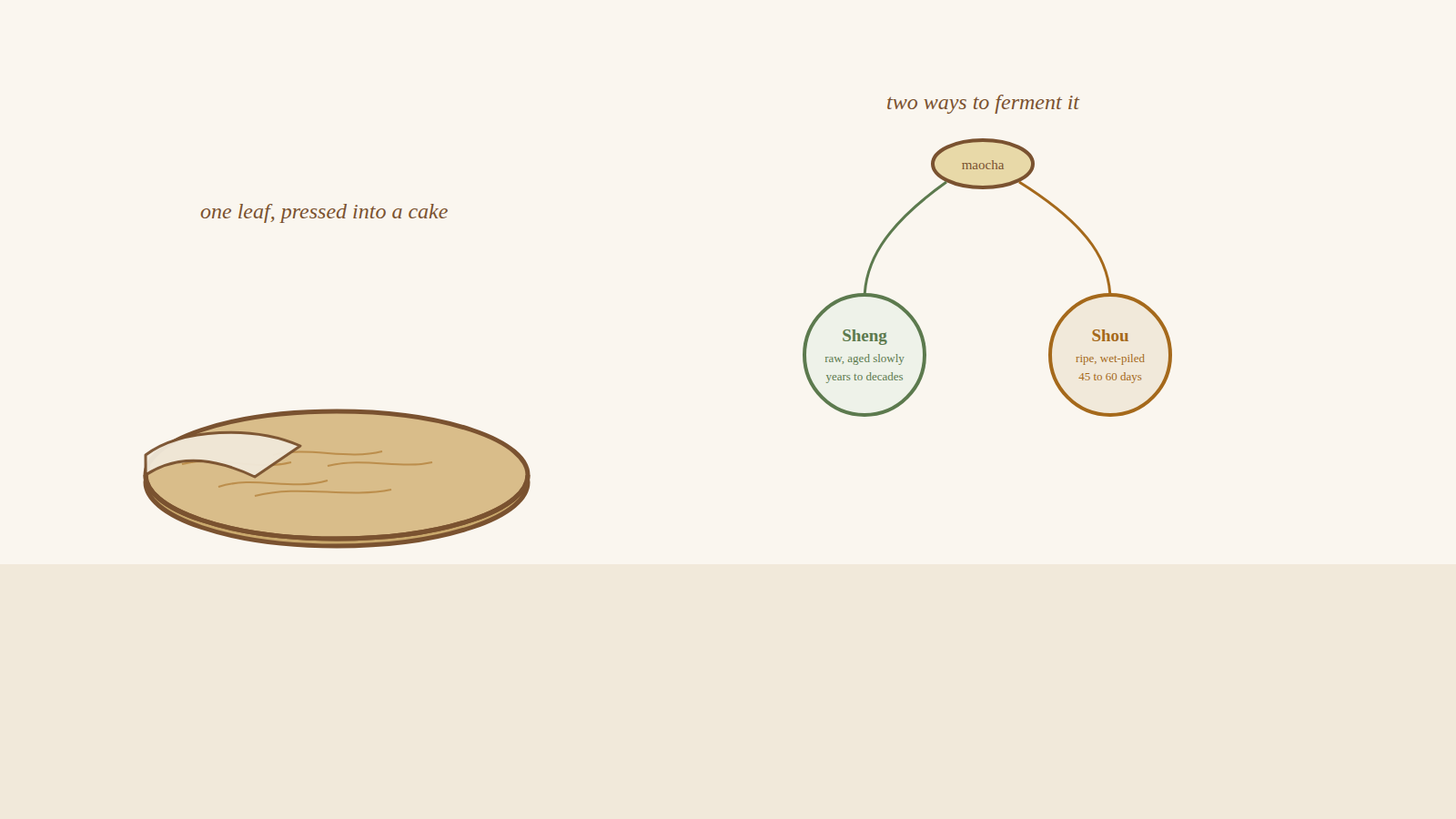
Every other tea category on this site gets defined by what happens to the leaf once, at processing. Pu-erh is the exception: it keeps changing after that, sometimes for decades, and the two main styles sold under its name, sheng and shou, aren't really variations on a theme. They're two different fermentation paths starting from the same leaf, and one of those paths didn't exist until 1973.
The starting material
Pu-erh comes from a specific large-leaf varietal, Camellia sinensis var. assamica, grown in Yunnan, China. The leaf is picked, withered, pan-fired briefly to halt most enzymatic activity, rolled, and sun-dried rather than oven-dried, producing an intermediate material called maocha. Maocha is the common ancestor of both pu-erh styles: what happens to it next is where sheng and shou completely diverge.
Sheng: raw, and left alone
Sheng ("raw") pu-erh is maocha that's steamed and pressed into cakes, bricks or other compressed shapes, then simply stored. Ageing happens slowly and largely uncontrolled, driven by residual enzyme activity, gradual oxidation and the environment's own microbial population, over years or, for the most sought-after examples, decades. A young sheng cake tastes bright, grassy and often quite astringent; the same cake at twenty years old can taste completely different: smoother, earthier, less bitter. That slow transformation, and the fact that it can't be rushed, is a large part of why aged sheng pu-erh commands the prices it does.
Shou: a 1973 shortcut
Shou ("ripe") pu-erh looks similar once finished, dark and earthy, but it gets there by a completely different, much faster route: wòduī, or wet piling. Moistened maocha is piled into large heaps, covered, and left to ferment under controlled heat and humidity for roughly 45 to 60 days, with the pile turned periodically to manage temperature and oxygen. The goal is to deliberately compress decades of sheng's slow transformation into about two months. This isn't an old technique: it was developed at the Kunming Tea Factory in 1973, specifically because export markets in Hong Kong and Southeast Asia wanted the character of aged pu-erh without waiting twenty or more years for it, and mass production began at the Menghai Tea Factory shortly after, from around 1975. Most pu-erh sold today, and nearly all of it at accessible prices, is shou rather than genuinely aged sheng.
What's actually doing the fermenting
Wet piling isn't a vague "fermentation" in the loose sense the word sometimes gets used in tea marketing: it's a real, microbially driven process. Research using high-throughput sequencing has identified Aspergillus niger as the dominant fungus in post-fermented pu-erh, alongside a supporting bacterial community; a 2024 study that inoculated tea directly with Aspergillus niger found it significantly altered the tea's metabolite profile, with roughly 200 compounds shifting, many involved in amino acid breakdown and formation, changes that track closely with the flavour shift wet piling is known to produce. Sheng's slow natural ageing involves a broader, less studied mix of enzymatic and microbial activity working over a much longer timescale, which is part of why its flavour development is harder to standardise or predict than shou's.
Same leaf, two different teas
It's worth being precise about what pu-erh actually is, because "it's fermented" undersells how different the two paths are: sheng is closer to a wine that develops with age through slow, largely passive change, while shou is closer to a controlled industrial fermentation designed to produce a consistent, ready-to-drink result in weeks rather than years. Both are legitimately pu-erh. Neither is a shortcut version of the other; they're just answering the same question, what does long-fermented tea taste like, by two genuinely different routes.