What "Orange Pekoe" Actually Means (It's Not a Flavour)
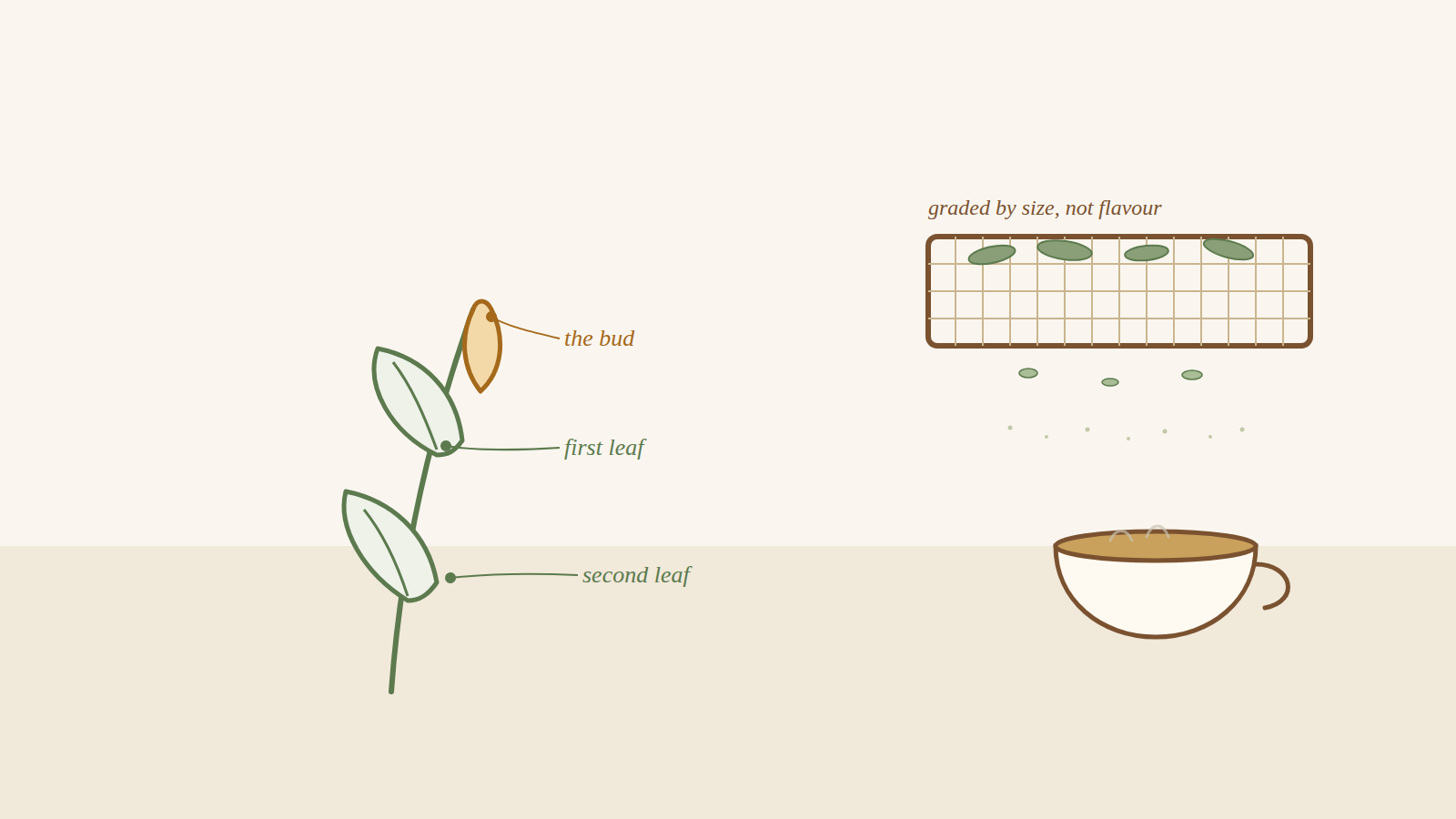
"Orange Pekoe" shows up on tea tins constantly, usually printed as though it names a variety or a citrus-scented blend. It does neither. Orange Pekoe is a grade: a classification describing leaf size and how much of the plant's bud made it into the tin, with no connection to orange, oranges, or flavour of any kind. It's one of the more persistently misread terms in tea, and the actual grading system behind it is more interesting than the myth.
Grading measures the leaf, not the taste
Tea grading exists to describe two things: how large or broken the processed leaf is, and how much of that leaf is bud rather than mature leaf. Neither has a fixed relationship to how the tea will taste, since that's determined by plant variety, terroir and processing. What grading actually tells a buyer is how the leaf was sorted after processing, mainly by passing it through a sequence of sieves with progressively smaller mesh.
The letters, decoded
The benchmark whole-leaf grade is OP, Orange Pekoe: leaf consisting mainly of the first leaf below the bud, sorted from the coarsest sieve. Everything built on top of that base grade is a qualifier describing more bud content or finer plucking:
- FOP (Flowery Orange Pekoe): made from the bud plus the first two leaves, a finer pluck than plain OP.
- GFOP (Golden Flowery Orange Pekoe): an FOP with a visible proportion of golden-tipped buds, the "golden" referring to the colour those tips take on during processing.
- TGFOP (Tippy Golden Flowery Orange Pekoe): a further step up, with an even higher proportion of tips.
- FTGFOP (Finest Tippy Golden Flowery Orange Pekoe): the top of the standard ladder, sometimes pushed even further with a numeric suffix (FTGFOP1) to mark a particularly fine lot.
Once the leaf is broken rather than whole, the letters shift again: BOP (Broken Orange Pekoe) and BOPF (Broken Orange Pekoe Fannings) describe smaller, broken fragments, down to fannings and dust, the finest sievings, mostly destined for tea bags rather than loose-leaf pots. None of these grades measure oxidation, so the same letter-grade system gets applied across black teas and, less commonly, some oolongs, while green and white teas typically use their own separate grading conventions.
So where does "orange" actually come from
Here the honest answer is that nobody knows for certain, and the two leading explanations both predate the modern tea trade by centuries. One traces it to the Dutch royal House of Orange-Nassau, the theory being that Dutch traders, among the first Europeans to import tea into Europe, attached the prestigious "Orange" name to signal a premium product, with no reference to colour or citrus intended. The other traces "pekoe" itself to the Chinese term pak-ho, roughly "white down," describing the fine white hairs on an unopened tea bud: under this account "orange" may be an English mishearing or adaptation of an unrelated word, layered onto "pekoe" over generations of trade. Tea reference sources generally present both as plausible without settling on one, which is itself telling: the name has been repeated for so long that its origin came loose from the record.
Why the grade is still worth knowing
Grade isn't a quality score, but it does predict how a tea behaves in the pot. Whole-leaf grades like OP and FOP hold their essential oils longer, oxidise more slowly, and generally want a gentler, longer steep, while broken grades and fannings expose far more surface area, extract faster, and brew a stronger cup in less time, which is exactly why CTC-processed tea and most tea bags sit at the broken-to-dust end of this same scale rather than the whole-leaf end. Neither end is objectively better; a fannings-grade Assam built for a strong, fast, milk-friendly cup is doing its job as well as a whole-leaf FTGFOP1 built for a slower, more delicate pour. The grade just tells a buyer what kind of cup to expect before the kettle goes on.