Home / Blog / Oolong oxidation
How Oolong's Oxidation Is Actually Controlled, Leaf by Leaf
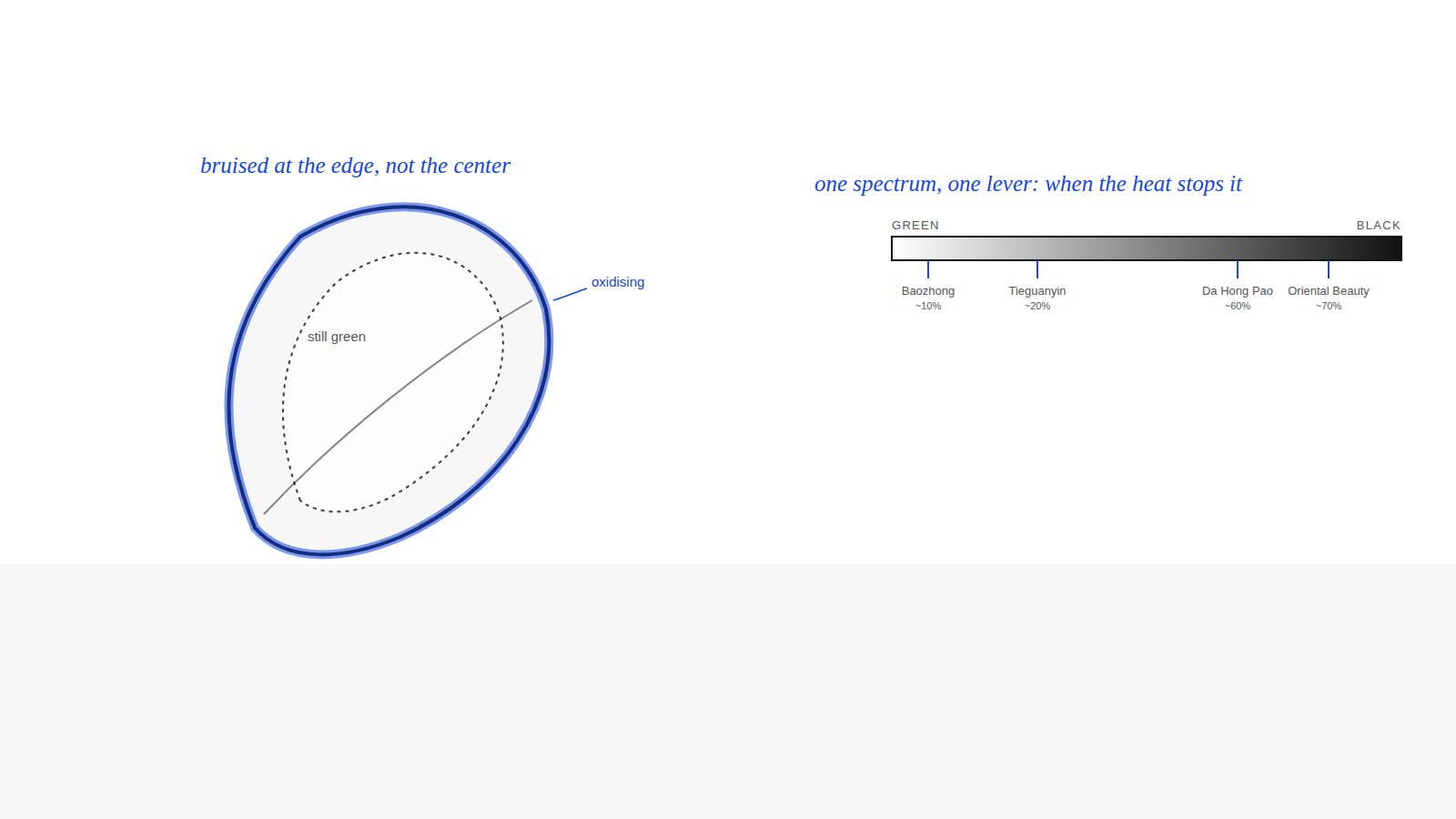
Oolong gets described as "partially oxidised" so often that the phrase stops meaning anything specific. It sounds like green tea left to oxidise for a while and then stopped partway through, as if oxidation were a single dial. It isn't. The defining technique behind oolong targets one part of the leaf and leaves another part alone, on purpose, in the same batch, at the same time.
Bruising the edge, not the leaf
The step responsible for this is called yao qing in Anxi and lang qing in Chaozhou, both of which translate roughly to "shaking" or "rocking" the green leaf. Producers toss, shake or tumble the leaves, often in bamboo trays or drums, in repeated cycles of agitation followed by rest. The physical action bruises the leaf, but specifically at the edges and the rim, where the leaf is thinnest and most easily damaged by friction against itself. That bruising ruptures cell walls, which is what lets the enzymes responsible for oxidation finally meet the polyphenols they oxidise. The center of the leaf, protected by the sturdier midrib and thicker tissue, mostly stays intact and keeps oxidising far more slowly, if at all.
A leaf with two different ages
The result, if the process is done well, is a single leaf with a visibly oxidised, reddish-brown rim around a center that's still green: not a blend of oxidised and unoxidised leaves, but one leaf doing both at once. That two-tone leaf is the actual signature of oolong, more fundamental than any specific oxidation percentage. It's also what separates oolong from its neighbours in processing terms: green tea is fixed immediately to prevent any oxidation at all, while black tea is rolled and bruised thoroughly enough that the whole leaf oxidises, not just the rim.
The one lever that decides the style
Once the leaf has oxidised as much as the producer wants, heat stops it: a step called sha qing, or kill-green, usually done by pan-firing or tumbling the leaf in a hot drum. This deactivates the enzymes driving oxidation and locks the leaf at whatever point it has reached. That single timing decision, how many rounds of shaking and resting happen before the pan, is the producer's main lever over the finished tea's character, and it's why oolong covers such enormous ground between green and black tea.
The spectrum in practice
Oxidation figures for named oolongs are not standardised, and producers and sellers routinely disagree on exact numbers for the same tea, so these are approximate rather than fixed: Taiwanese Baozhong sits lightly oxidised, often cited around 8 to 15 percent, closer to green tea in character. Tieguanyin from Fujian generally runs higher, roughly 15 to 30 percent depending on style. Da Hong Pao, a roasted Wuyi oolong, is usually described as 50 to 80 percent oxidised, considerably closer to black tea. Oriental Beauty sits at the heavy end too, commonly cited around 60 to 80 percent, with its oxidation partly driven by the same leafhopper bite covered in an earlier post on Darjeeling's muscatel character: damaged leaf oxidises differently than undamaged leaf, whatever the cause of the damage.
Same plant, same rough sequence of steps, but the number of shaking cycles before the pan stops everything is what actually decides whether a given oolong reads closer to a green tea or closer to a black one.