Crema Is Dissolved CO2 Escaping, and It Needed a Pressure Jump to Exist
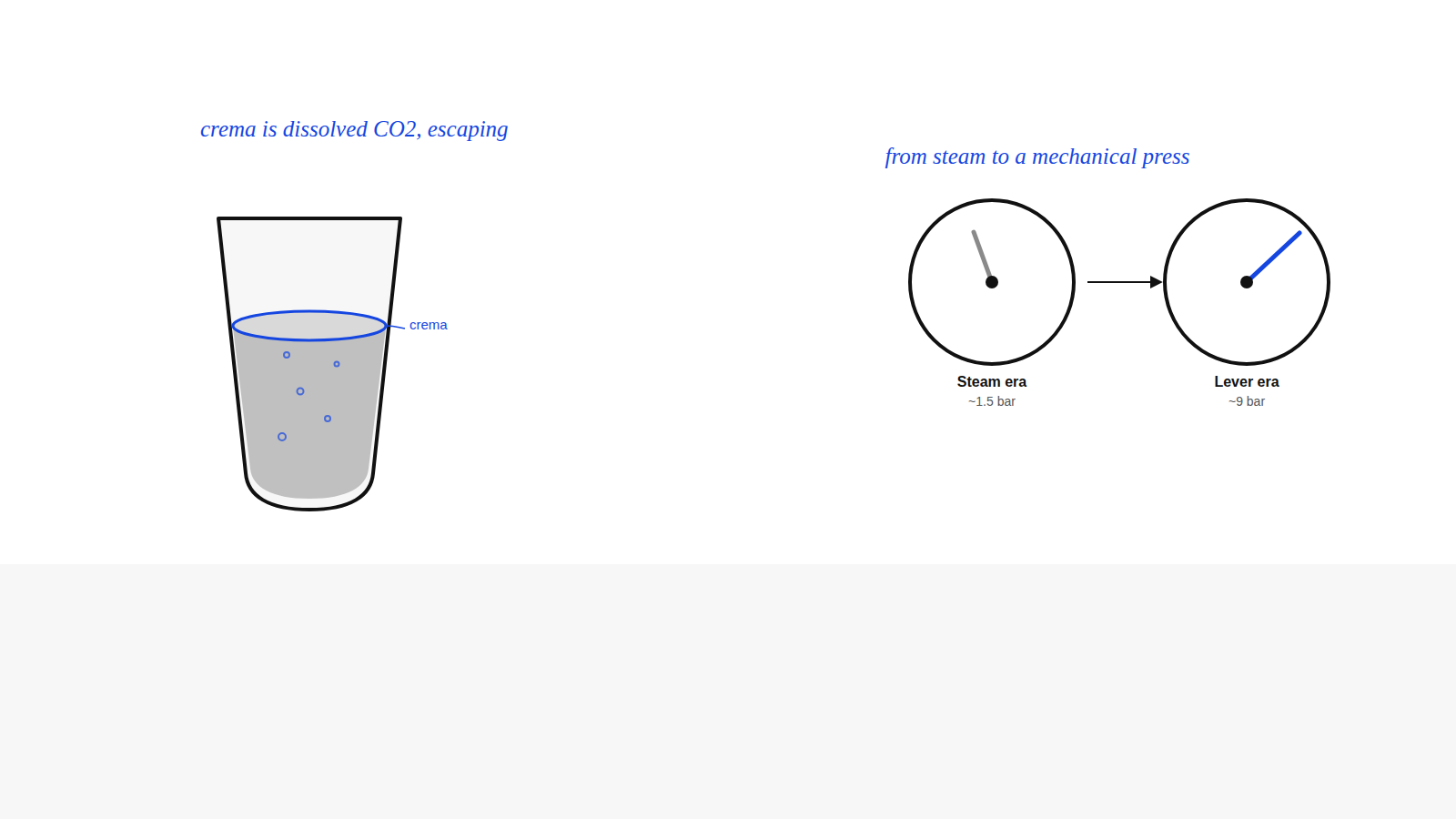
An earlier post on this site covered the 1884 machine that first pushed pressurised hot water through coffee grounds on demand. That machine, and the ones that improved on it over the following decades, still couldn't reliably produce the reddish-brown foam now treated as the signature of a proper espresso. Crema needed a second, much larger jump in pressure, and it took roughly fifty more years to arrive.
Steam pressure wasn't enough
Early espresso machines, including Angelo Moriondo's 1884 design and the ones Luigi Bezzera refined in the early 1900s, generated pressure using steam itself, generally topping out at somewhere around 1.5 bar. That was enough to brew considerably faster than a pot-based method, which was the whole point at the time, but it wasn't enough pressure to force much dissolved gas out of the grounds during extraction. Coffee from these machines was strong and fast, not crema-topped.
A spring-loaded lever changes the pressure available
The shift came from Achille Gaggia, who filed a patent in 1938 for a mechanism that replaced steam pressure with a spring-loaded piston lever: a barista pulled the lever down by hand, compressing a spring that then drove water through the grounds under far higher pressure than steam alone could generate, commonly cited at roughly 8 to 10 bar. Commercial machines using the design reached Italian cafes through the 1940s. That roughly 9 bar figure stuck, and it's still the standard most modern pump-driven espresso machines are built around.
What crema actually is
Freshly roasted coffee holds a meaningful amount of carbon dioxide, trapped in the bean during roasting and only slowly released afterward. Under espresso's roughly 9 bar of pressure, that CO2 stays dissolved in the hot water passing through the grounds. The moment the liquid exits the portafilter and the pressure drops back to normal, the dissolved CO2 can't stay in solution anymore and comes out as a flood of microscopic bubbles. On its own, that foam would collapse in seconds. It persists because coffee's own oils and melanoidins, the same brown polymer compounds formed by the Maillard reaction during roasting, act as natural surfactants, coating the bubbles and holding the foam together.
Why crema fades as beans age
This mechanism makes crema a genuinely useful, not just decorative, signal. Beans hold the most dissolved CO2 in roughly the first one to two weeks after roasting, which is why coffee from recently roasted beans produces the thickest, most persistent crema. As beans age past that window and gradually off-gas, there's simply less CO2 left to release under pressure, and crema thins out accordingly: a visible readout of roughly how fresh the beans actually are, sitting right on top of the cup.
Crema, in the end, is two separate things lining up: enough mechanical pressure to pull dissolved gas out of solution in the first place, and beans fresh enough to still have gas worth releasing. Neither alone produces it.