How Coffee Actually Gets Decaffeinated, and Why It's Never Fully Caffeine-Free
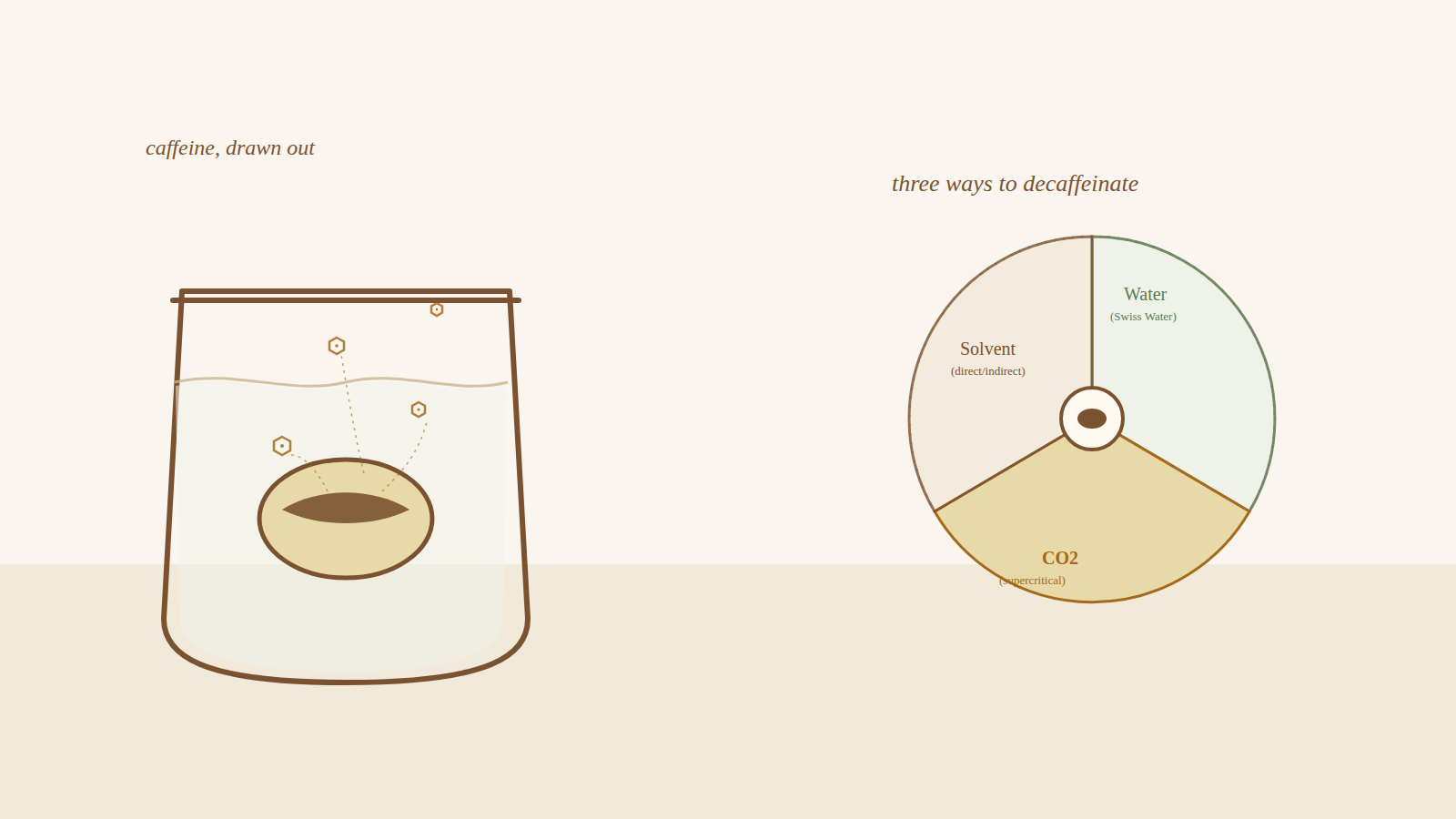
"Decaf" gets treated as a fixed state, as if caffeine were simply switched off. It isn't. Decaffeination is a set of very different industrial processes, applied to green (unroasted) beans before roasting even starts, and each one pulls caffeine out through a different mechanism, with different trade-offs for flavour, cost and residue.
The water method
The best-known chemical-free approach is the Swiss Water Process, developed in Switzerland and commercialised in Canada in the 1980s. Green beans are soaked in a solution called green coffee extract: water that's already fully saturated with every soluble compound naturally found in coffee except caffeine. Because that solution has no room left for flavour compounds, it can't pull them out of the beans, but it still has a strong pull on caffeine specifically, drawing it out by diffusion, roughly the same principle behind osmosis. The caffeine-laden extract is then run through activated carbon filters that trap caffeine molecules while letting the flavour compounds pass through, so the same extract solution can be reused on the next batch. The whole process takes around 8 to 10 hours and typically removes about 99.9 percent of the bean's caffeine, with no solvent involved at any stage.
The carbon dioxide method
The second major approach uses carbon dioxide in a supercritical state: pressurised and heated past the point (roughly 31°C and 74 bar for CO2) where it behaves as something between a liquid and a gas, dense enough to act as a solvent but able to diffuse through the bean like a gas. Beans are first soaked in water to swell and open their cell structure, then supercritical CO2 is pushed through them under high pressure. CO2 happens to bind selectively to caffeine's molecular structure, so it extracts caffeine efficiently while leaving most larger flavour and aroma compounds largely intact. Once saturated, the CO2 is moved to a separate chamber, depressurised, and the caffeine is removed, and the CO2 itself is recycled for the next batch. This method is capital-intensive to set up but leaves no chemical residue, which is why it's common at large-scale specialty roasters.
Solvent-based methods
The older, still widely used approach uses a chemical solvent, either methylene chloride (dichloromethane) or ethyl acetate, applied one of two ways. In the direct method, steamed green beans are repeatedly rinsed with the solvent, which bonds to caffeine molecules, then the beans are steamed again to evaporate the solvent off before roasting. In the indirect method, beans are first soaked in hot water, which draws out both caffeine and flavour compounds together, then that water is treated separately with the solvent to strip out just the caffeine, and the now caffeine-free, flavour-rich water is reabsorbed back into the beans, essentially the same logic as the water process but using a chemical extraction step instead of saturated green coffee extract. Regulators cap how much solvent can remain: in the United States, the FDA limits residual methylene chloride to 10 parts per million in decaffeinated coffee, while the European Union sets a stricter limit of 2 parts per million; actual residues in finished coffee typically measure far below either threshold.
Why "decaf" is never zero
Every method above targets a reduction, not a total elimination, and industry practice generally treats somewhere around 97 to 99.9 percent caffeine removal as the practical ceiling, not exactly zero. A cup of decaf coffee can still contain a small residual amount of caffeine, typically a few milligrams against the roughly 95 milligrams in a regular cup. That's a meaningfully different situation from a plant that never had caffeine to begin with, such as rooibos or chamomile: those are naturally caffeine-free by botany, not by industrial process, and are the more reliable choice for anyone who needs a genuinely zero-caffeine cup rather than a heavily reduced one.