Home / Blog / Darjeeling flushes
The Insect Bite Behind Darjeeling's Most Prized Flavour
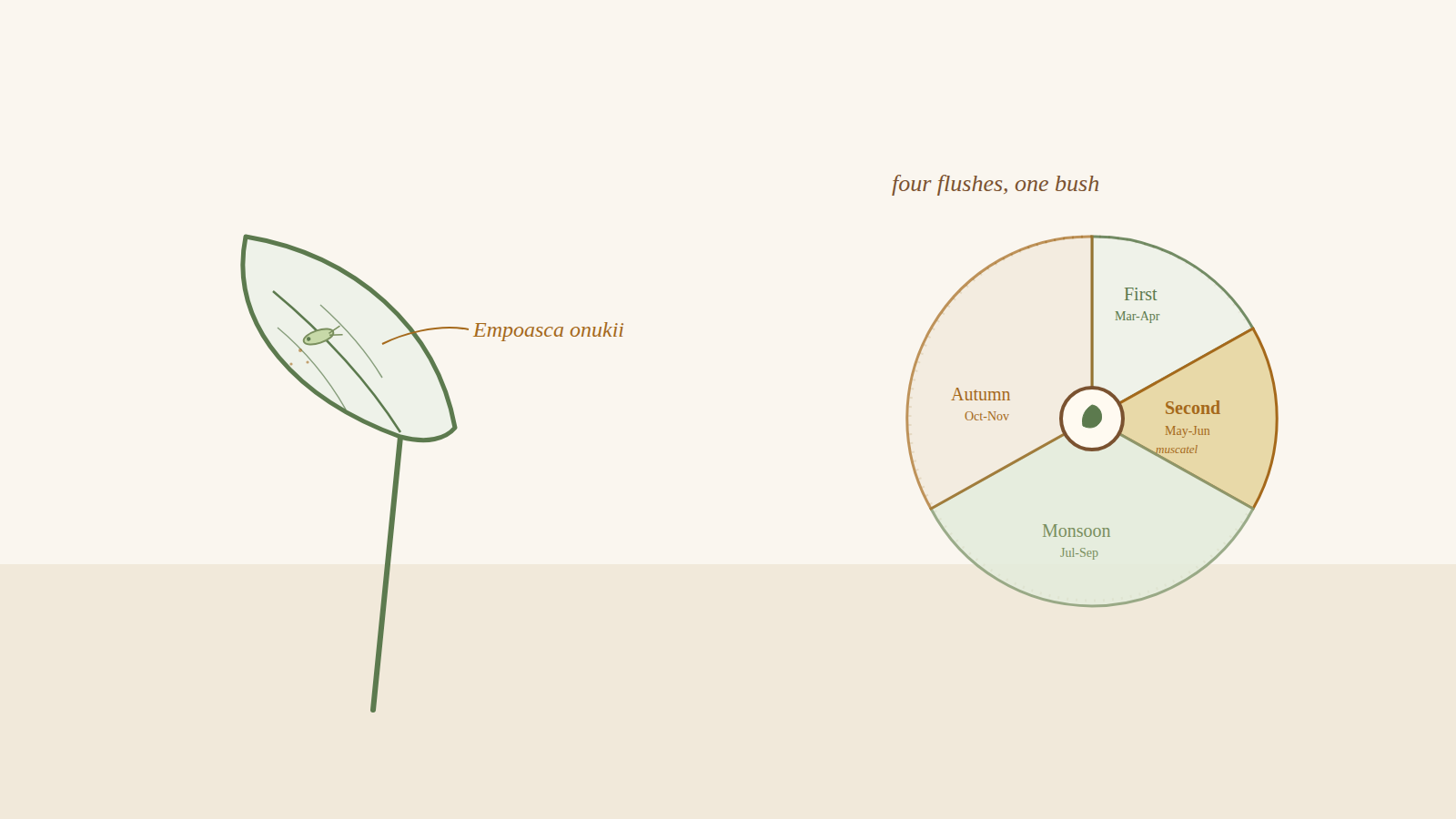
Growers spend most of their effort keeping insects off tea bushes. In Darjeeling, during one specific harvest window, they deliberately let a particular insect stay. That's not an oversight: the bite marks it leaves behind are directly responsible for the most sought-after, expensive flavour Darjeeling produces.
One bush, four different teas
Darjeeling tea isn't a single product picked whenever the leaf is ready. It's harvested in four seasonal windows, called flushes, and the same bushes produce genuinely different teas depending on which flush the leaf comes from, shaped by the season's temperature, rainfall and light rather than any change in processing:
- First flush (March to April): the spring harvest, right after winter dormancy ends. Light-bodied, floral and bright, often slightly astringent, and prized for delicacy.
- Second flush (late May to June): fuller-bodied and rounder, with the distinctive muscatel character Darjeeling is best known for. This is generally the most expensive and sought-after flush.
- Monsoon flush (July to September): harvested during the rainy season, when rapid growth produces a stronger, less nuanced leaf. Mostly used for everyday blends and iced tea rather than sold as a standalone premium tea.
- Autumnal flush (October to November): mellower and coppery-coloured, generally considered second in prestige after second flush, with a rounder, less bright character than spring's harvest.
What "muscatel" actually is
Muscatel is the name tea tasters gave to the wine-like, grape-forward aroma found in the best second-flush Darjeeling, named for its resemblance to Muscat grapes. For a long time, that resemblance was treated mostly as a tasting-note curiosity. The actual mechanism behind it turns out to be an insect.
The leafhopper's role
The driver is a tiny sap-sucking insect, the green leafhopper (Empoasca onukii), which feeds by puncturing the underside of young tea leaves to draw out plant fluid. That puncturing is a real injury, and the tea plant responds to it the way plants generally respond to insect damage: by producing defensive chemical compounds. In this case, those compounds are terpenes, specifically geraniol and linalool, which happen to be two of the primary aromatic molecules that give Muscat grapes their scent in the first place. The plant isn't making a wine-flavoured compound on purpose; it's making an insect deterrent that, chemically, tastes like one.
Second flush coincides with the leafhopper population's active season in the Darjeeling hills, which is precisely why that flush, and not first flush or autumnal flush, develops the muscatel character. Growers don't need to introduce the insect deliberately: the timing does that on its own. What they do is avoid spraying it away as aggressively as pure pest-control logic would otherwise call for, tolerating a level of leaf damage that would be treated as a problem on almost any other crop.
Not a coincidence unique to Darjeeling
The same mechanism, insect damage triggering a defensive terpene response that produces a prized flavour, is the underlying reason Taiwan's Oriental Beauty oolong (also called "bug-bitten tea") gets its honeyed, fruity character, from a closely related leafhopper feeding on the leaf before harvest. Two different tea traditions, on two different continents, independently learned to work with the same insect-driven chemistry rather than eliminate it.
It's a useful reminder that "damage" and "defect" aren't fixed categories in agriculture: the exact thing a grower would eliminate without a second thought on most crops is, on this one, the reason the tea is worth more.